
Google AI Mode Ads Are Coming to the UK: What Advertisers Need to Do Before They Land
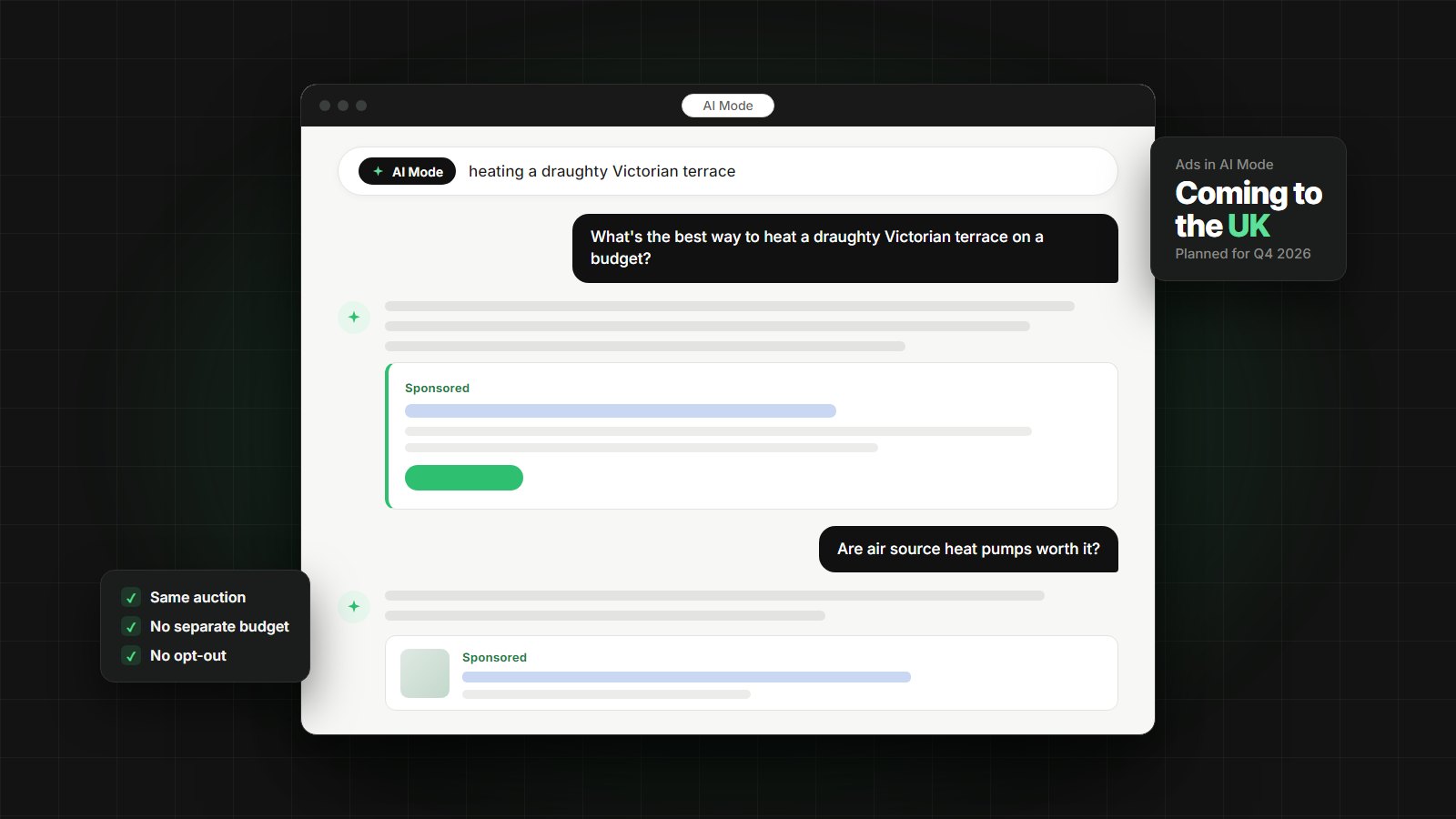
Ads are moving inside Google's AI answers, and UK advertisers are next in line. On 28 October 2026, Google expanded ads in AI Mode to ten more countries and switched on "multiturn" ads in the US, which follow users into their follow-up questions.
If you run Search, Shopping or Performance Max campaigns, you are probably already eligible. You won't get a separate toggle, a separate budget or a separate report. That makes now the time to prepare, before the format reaches British search results rather than after.
This guide covers what Google announced, how the ads work, where advertisers lose control, and a practical checklist to get ready.
What Google announced on 28 October
Google took AI Mode ads global for the first time, and the UK is on the list for Q4 2026. The announcement came alongside Alphabet's third-quarter earnings, and it had three parts:
- Ten new markets: Australia, Canada, India, Kenya, Malaysia, New Zealand, Nigeria, Pakistan, the Philippines and Singapore.
- Multiturn ads in the US: sponsored results can now appear in follow-up questions, not just the first query of a conversation.
- More to come: Brazil, Mexico and the United Kingdom are planned for Q4 2026.
The timing tells you why. Google Search revenue grew 12% in the quarter, down from 17% in Q2 and 19% in Q1, according to TechCrunch. Google's Chief Business Officer, Philipp Schindler, named lower monetisation in AI Mode as one of the reasons for slower growth, as Search Engine Journal reported.
In plain terms: AI answers are absorbing searches that used to carry ads, and Google needs ads back in those answers. Expect it to push this format hard.
How AI Mode ads work
AI Mode ads run on your existing campaigns, through the same auction, at no extra charge. There is nothing new to build.
| What | How it works |
|---|---|
| Eligible campaigns | Existing Search, Shopping and Performance Max campaigns. Broad match and AI Max with search term matching matter here. |
| Setup | No new campaign type and no separate budget. |
| Auction and bidding | Same auction, same CPC or conversion-based bidding as standard Search ads. |
| Cost | Google says there is no extra charge to appear. |
| Labelling | Ads are marked "Sponsored" inside or alongside the AI answer. |
| Placement | Inside AI Overviews and AI Mode answers when relevant to the query and response; in the US, in follow-up queries too. |
| Organic answers | Google says ads do not influence the AI-generated organic responses. |
Google is also testing new formats built for this surface. One is a Direct Offer asset that serves promotions to high-intent shoppers within AI Mode. Another is a carousel layout that groups paid products under a "Sponsored" heading and unpaid ones under "All products", reported by PPC Land.
The catch: less control, less visibility
The easy setup comes at a price: you can't opt out, can't fully control your ad text, and can't measure AI Mode on its own.
No separate opt-out. You cannot target AI Overviews or AI Mode exclusively, or exclude them while staying in Search. If your campaigns qualify, you're in. Your levers are the old ones: negative keywords, brand exclusions and asset pinning.
Text you didn't write. Some ads show AI-generated explanations created by Gemini. These sit outside your headlines and descriptions. You cannot write, edit or approve them, and you cannot switch them off. For regulated sectors such as finance, legal and healthcare, that should prompt a compliance conversation now.
Blended reporting. AI Mode performance is folded into standard campaign and search terms reports, with no separate segment. Any lift or drag will be hard to isolate from the rest of your Search results.
Unproven performance. Google says click-through rates are similar for sponsored and organic product listings in AI Mode. But that comes from Google's own US data, and similar click rates don't prove profit. Treat it as a claim to test, not a benchmark.
Why your keyword list matters less
AI Mode queries are longer, more conversational and often multi-step, and Google matches ads to the whole AI answer rather than just the words typed.
Google's May 2026 AI Mode report put the average AI Mode query at three times the length of a traditional search. It also said more than one in six US AI Mode searches were multimodal, using images, video or voice. On its Ads Decoded podcast in October, Google repeated these figures without those qualifiers, as PPC Land pointed out. So treat them as AI Mode, US-only figures for now.
The matching is the bigger change. Google's Ads Liaison, Ginny Marvin, said ads in AI Mode and AI Overviews are matched to both the query and the content of the AI response. Picture someone asking "what's the best way to heat a draughty Victorian terrace on a budget?", then following up with "are air source heat pumps worth it?". No exact-match keyword list anticipates that conversation. Broad match, AI Max and good product data do.
Two more data points are worth knowing:
- Queries are moving up the funnel. Google says people ask more brainstorming and research questions, so AI Mode ads reach people earlier than a typical last-click search.
- Product visibility shrinks. A Productrise study of over 100,000 US and UK queries found AI Mode showed roughly 95% fewer product listings than standard search. Fewer slots means more competition for each one.
A pre-launch checklist for UK advertisers
You can't opt out, so the job is to make sure your campaigns behave well when AI Mode ads arrive. Work through these before the end of the year.
- Benchmark now. Record current CTR, CPC, conversion rate and impression share by campaign. AI Mode data will be blended into your reports, so a clean "before" picture is the only way to spot a shift.
- Audit broad match and AI Max. These are the routes into AI Mode. Check search terms reports for irrelevant matches and decide where you want that reach.
- Tighten negatives and brand exclusions. They are your main controls. Refresh negative keyword lists and set brand exclusions for brands you never want to appear next to.
- Pin what must not change. If certain claims or wording are legally required, pin those assets. Remember that Gemini-written explanations can still appear alongside.
- Brief compliance teams. In finance, legal, healthcare and other regulated sectors, flag that some ad text will be AI-generated and outside your approval.
- Enrich your product feed. Fill in Merchant Center thoroughly, including Google's new conversational attributes. Detailed, accurate feeds give the AI more to match against long, specific questions.
- Upgrade landing pages. Users arrive mid-research with detailed questions. Pages with specific answers, comparisons and clear next steps will convert better than generic product blurbs.
- Refresh creative assets. Supply a full range of headlines and descriptions that cover discovery and consideration, not just "buy now" intent.
- Watch for the UK rollout. Check Google Ads announcements and the help page on ads in AI Overviews and AI Mode, then compare post-launch results against your benchmark.
What it means for SEO
Organic results now share the AI answer with ads, so paid and organic teams need to plan together.
Google says ads don't influence the AI-generated organic responses. But they compete for the same attention. In the carousel test, sponsored and unpaid products sit side by side under separate headings, with fewer product slots overall.
Organic clicks were already under pressure. A randomised study by researchers at the Indian School of Business and Carnegie Mellon found AI Overviews cut outbound organic clicks by 39.8%. Adding ads to the same answers raises the bar for organic content further.
Google's own advice for both sides sounds familiar: specific, detailed, authoritative content wins. Its Search research lead said users increasingly favour specialised, unique answers over generic ones. That's useful for both SEO and PPC landing pages, so it's a good reason for the two teams to share content plans and query insights.
The bottom line
AI Mode ads are coming to the UK whether you prepare or not, and they will arrive inside campaigns you already run. Google needs this format to work, so expect it to grow quickly.
The advertisers who do well will be the ones who benchmark early, tighten their controls, and feed Google's AI rich, accurate information about what they sell. Start now, and you'll be able to tell whether AI Mode is helping or hurting your account when it lands.
Sources
- Let's Data Science: Google expands ads in AI Mode to ten more markets
- TechCrunch: Google expands AI Search ads globally as core ad growth slows
- Search Engine Journal: Google says lower AI Mode monetization weighed on Search growth
- PPC Land: Google tells advertisers AI search queries now run 3x longer
- PPC Land: Google AI Mode test groups shopping ads under one Sponsored heading
- Search Engine Land: Google Ads tests new Direct Offer asset for AI Mode promotions
- PPC Land: AI Mode cuts Google Shopping listings 95%, Productrise finds
- PPC Land: AI Overviews cut publisher clicks 39.8% in first randomized study